Blog
DX Coil vs. Chilled Water Coil: Selection Guide for Commercial HVAC
Choosing between a DX coil and chilled water coil can affect the entire HVAC system, down to plant space, piping, controls, maintenance, first cost, and long-term energy use.
In this guide, we help mechanical engineers, contractors, and facility managers compare both options and match the cooling method to their building load, operating profile, available space, and service strategy.
Overview of Cooling Coils, Chilled Water, and DX Systems
A cooling coil is a heat exchanger that takes sensible heat away from an airstream. Also, it eliminates moisture when its surface falls below the air's dew point.
What's the difference between DX cooling and chilled water? Direct expansion equipment evaporates refrigerant inside the coil to cool the air directly, while a chilled water system cools water at a central chiller before pumping it to each water coil. With both designs, the cooling medium absorbs heat from the air passing across the finned surface.
How Cooling Coils Work: Chilled Water Coil vs DX Coil
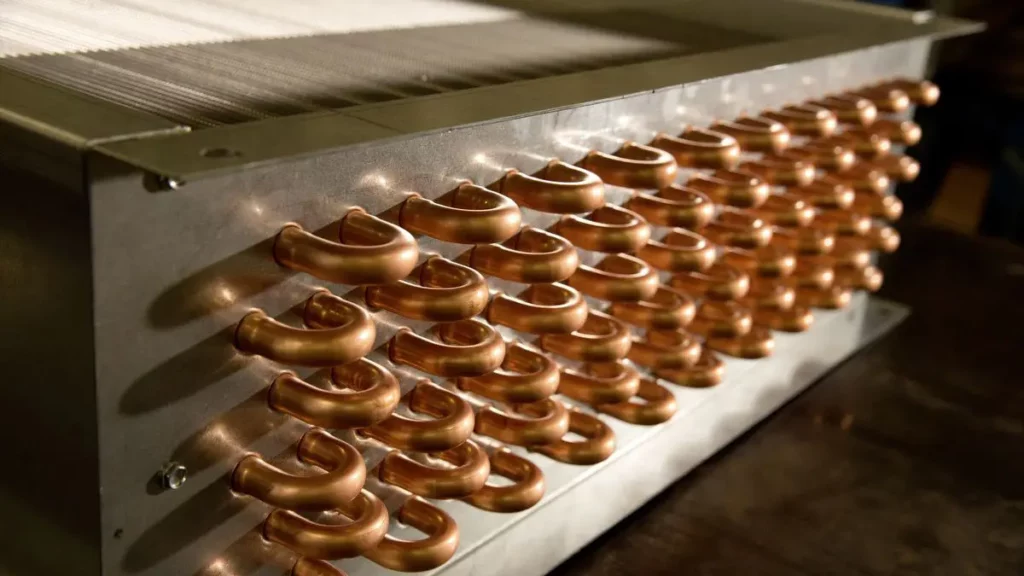
Most commercial coils couple copper tubes with closely spaced aluminum or copper fins. The fins add heat transfer surface, and the circuits carry refrigerant or water.
With DX coils, an expansion device meters refrigerant into the evaporator, typically as a low-pressure mixture of liquid and vapor. That refrigerant boils as it absorbs heat, then it returns to the compressor as vapor. With chilled water coils, a pump circulates cold water throughout the tubes, then it sends the warmed water back to the chiller.
Either coil can remove moisture, but it's crucial that the drain pan and condensate line are properly sized, trapped, and sloped.
Types of Cooling Coils and Common Applications
Four of the most common commercial HVAC families are water coils, steam coils, DX evaporator coils, and refrigerant condenser coils. Fin-and-tube construction is used across cooling applications, and flooded evaporators offer another refrigerant arrangement for systems seeking a small air-to-refrigerant temperature difference.
DX systems serve split systems, computer-room units, and packaged rooftop equipment. Chilled water coils, meanwhile, are familiar sights in central-station and rooftop AHUs, fan coil units, hospitals, campuses, and large commercial buildings.
Chilled Water Systems: Components and Interfaces
A central chilled water system features a chiller, pumps, supply and return piping, valves, controls, air separators, and terminal equipment. A water-cooled chiller rejects heat through condenser water and a cooling tower, and an air-cooled chiller sends heat outdoors through condenser coils and fans, eliminating the tower and condenser-water loop.
Engineers are tasked with accounting for pump head, pipe length, insulation, balancing, water treatment, and water velocity. Chilled-water distribution systems can serve multiple air handlers, zones, or buildings when designed with appropriate pumping, piping, insulation, balancing and controls. Air-handling units and fan-coil units transfer cooling from the water loop to the local airstream.
Direct Expansion (DX) Systems: Components and Sizing
DX coils are evaporator coils where refrigerant changes from a liquid-rich mixture to vapor inside the tubes, absorbing heat from indoor air. The compressor raises the vapor pressure, the condenser rejects the heat and returns the refrigerant to liquid, then the expansion device meters flow back to the coil. DX units differ from chillers since they cool air at the evaporator instead of producing chilled water for distribution.
DX capacity can run from small split systems to large, packaged equipment. DX typically fits commercial buildings up to around 60,000 square feet, although that isn't a hard cutoff. Final sizing should always come from the load calculations and manufacturer data. Indoor coils can sit in rooftop units, AHUs, fan coils, or close-control units; however, the refrigerant line length, elevation, and pressure drop all limit placement.
Energy Efficiency Comparison: Chilled Water vs DX Systems
Broad planning ranges put DX system input at 0.7 to 1.0 kW/ton and chilled water at 0.6 to 0.8 kW/ton. Treat those figures as a starting point, though. Packaged DX equipment is commonly rated with EER or IEER, while chiller efficiency is commonly stated in kW/ton.
Chilled water tends to lower operating costs in large facilities through efficient central equipment, staging, and temperature control. Water also has more than four times the specific heat of air by mass, making it an effective cooling medium. DX performs very well for smaller, modular loads without adding pump or cooling tower energy.
For a useful comparison each year, include the hourly load profile, local weather, utility rates, fan and pump power, water use, and maintenance. Use IPLV or IEER when its rating conditions fit the project. Variable-speed compressors, pumps, and fans, plus staged equipment, reset schedules, and demand-based controls, can also improve part-load results.
Maintenance, Reliability, and Serviceability of Cooling Coils
For chilled water coils, clean the fins and pans, inspect the valves and pumps, check the strainers, vent trapped air, review water treatment, and look for leaks, corrosion, fouling, or freeze damage. Chillers require regular service, but with well-managed water chemistry and operation, chilled water components usually have longer service lives than DX components.
Localized DX equipment makes maintenance straightforward, but each unit adds a compressor and refrigerant circuit that can fail. Compressors still need consistent service: clean the coils, inspect the drain pans, check the charge and superheat, test the controls, and look for oil stains or damaged joints. Additionally, refrigerant management calls for careful installation and qualified technicians; EPA Section 608 rules apply to certain equipment and refrigerants.
Installation and Retrofitting Considerations
Before fabrication begins, be sure to confirm cabinet access, coil weight, pull space, face area, and available fan static pressure, also checking coil dimensions against the opening. For water coils, carefully review the pipe routing, drainage, venting, freeze protection, and pump capacity. And for DX, verify the refrigerant type, line length, lift, oil return, and distributor orientation.
Commissioning covers pressure or leak testing, airflow measurement, water-flow balancing, refrigerant charging checks, valve and control sequences, and condensate testing, as well as recorded entering and leaving conditions.
When To Choose Chilled Water Coils vs DX Coils
| Decision factor | Chilled water coil | DX coil |
|---|---|---|
| Common | Large buildings, campuses, and central plants | Small-to-mid-size buildings and modular zones |
| Capacity screen | Attractive above 75 tons | More practical below that range |
| Initial investment | Higher plant and piping investment | Often lower cost and quicker installation |
| Redundancy | Central equipment can be staged | Independent units limit a failure to one zone |
| Space | Requires mechanical-room and piping space | Requires refrigerant routing and outdoor heat rejection |
| Service | Chiller, pump, and water-treatment work | Refrigerant, compressor, and coil service |
In short, choose chilled water when scale, long distribution runs, close temperature control, and central redundancy can justify the plant. DX, on the other hand, has the advantage when speed, modularity, limited space, and lower initial cost drive decision-making. A phased campus can also take a hybrid approach, with central chilled water for core loads and DX for additions, remote rooms, or temporary capacity.
Specification Checklist for Engineers and Contractors
- Coil dimensions, casing material, coating, and connection locations
- Tube outside diameter, wall thickness, fin material, fin spacing, and row count
- Airflow, entering and leaving conditions, capacity, and pressure-drop limits
- Circuiting, refrigerant and distributor data, or water velocity and flow targets
- Drain-pan, access, lifting, and service-clearance requirements
- AHRI 410 certification, pressure testing, and applicable ANSI/UL compliance
Custom Chilled Water Coils and DX Coils
Precision Coils manufactures custom chilled water coils and DX evaporator coils for replacement, OEM, and design-build work. Customers can choose from copper or aluminum fins, with galvanized, stainless steel, or copper casing options.
When time is tight, our Quick Build Program offers expedited production options, subject to factory approval, product details, and current availability. Customers can use PC Select to configure, price, and order coils based on dimensional and performance requirements.
Request a quote for replacement, OEM, or design-build coils, or contact our sales team to discuss material samples, measurements, and expedited options.