Blog
How Chilled Water Coils Work
If you've ever wondered, “How do chilled water coils work?” the answer is straightforward: they move heat from an air stream into a water loop.
A chilled water coil is a finned-tube heat exchanger installed in an air handling unit (AHU) or fan coil, common across commercial HVAC systems, data centers, hospitals, laboratories, and industrial plants.
These types of HVAC systems are often called hydronic systems, since the water carries thermal energy between the coil and a central chiller. Chilled-water supply temperatures vary by system design, although many comfort-cooling systems operate with supply water in the low-to-mid 40°F range. The warmed return water travels back to the chiller, where the absorbed heat is removed before pumps circulate the cooled water through the system again.
How Chilled Water Coils Work in Cooling Systems
AHU fans move warm air across cold tubes and fins. Heat moves by convection from the air to the fin surface, by conduction through the metal, then into the water. Control valves vary the water flow as cooling demand changes. Cooled air returns to occupied rooms or process areas through ductwork.
This provides a practical cooling method that can also lower dry-bulb temperature. When the coil surface is colder than the air's dew point, water vapor condenses on the fins, and that latent cooling removes moisture. A sloped condensate pan then catches the water and routes it to the drain.
Chilled Water Coil Construction and Components
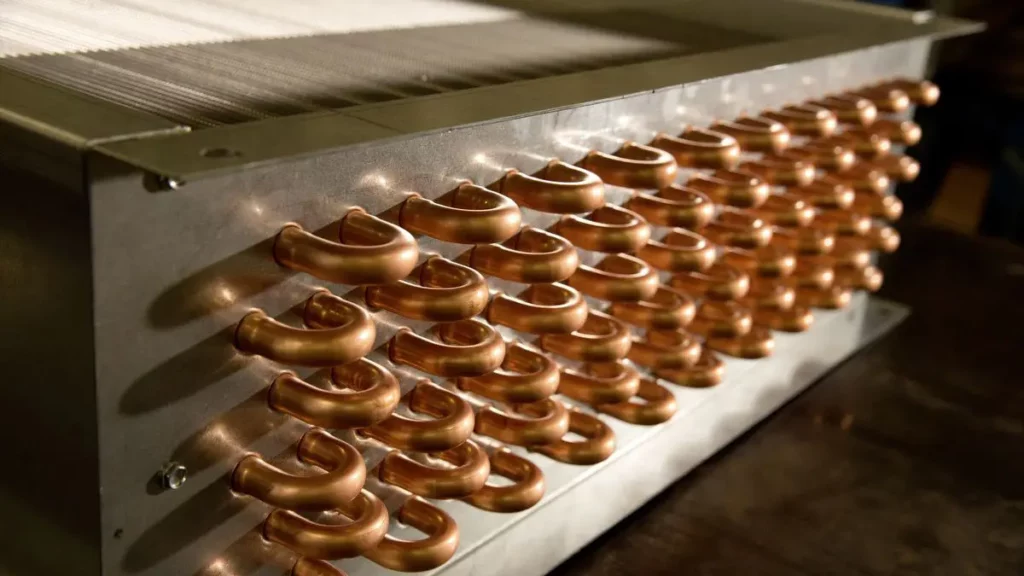
Typically, water coils use 1/2-inch or 5/8-inch copper tubes bonded to aluminum fins. A 5/8-inch tube provides lower water pressure drop and greater wall-thickness, while a 1/2-inch tube offers a more compact coil. At Precision Coils, we build chilled water coils with one to 12 rows.
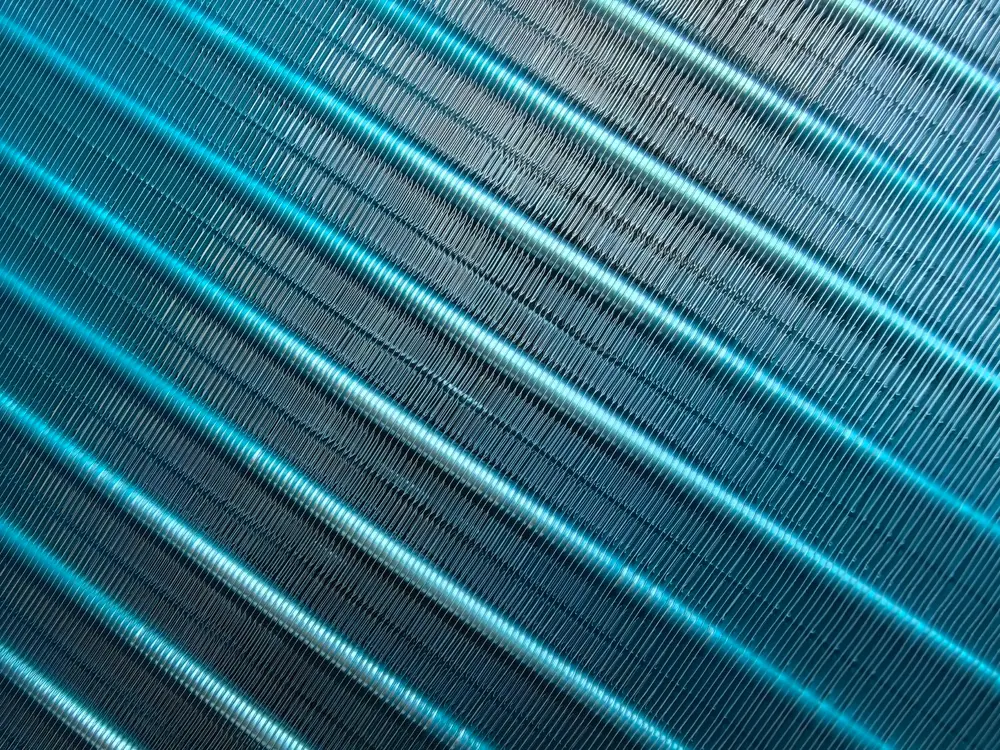
Fin density can range from four to 20 fins per inch (FPI), depending on tube size and design. More fins add surface area, but they can also restrict airflow and collect more debris. Headers distribute water among the circuits and collect it at the outlet; copper, carbon steel, and stainless steel headers are all available, along with threaded, sweat, and grooved connections. Casings come in galvanized steel, stainless steel, aluminum, or copper.
Cooling Coils vs. Direct Expansion (DX) Coils
Water cooling coils receive a hydronic feed from the supply and return headers. On the flip side, direct expansion coils receive refrigerant through one or more distributors, then return the vapor through a suction header.
Why use chilled water instead of refrigerant? Water loops can serve many AHUs and scale across campuses. Central plants can also be highly efficient when pumps, chillers, and controls operate as one system. DX, meanwhile, is more practical for smaller, self-contained, or single-zone equipment.
Coil Construction Variables That Affect Performance
Adding tube rows creates more heat transfer surface and raises capacity. It also increases air pressure drop, which raises fan power. Higher FPI improves heat transfer within the same face area, but the tighter fin spacing also heightens resistance, as well as the cleaning demands. For cleanability, ASHRAE limits dry-coil pressure drop for certain finned-tube coil arrangements.
Circuiting controls the number and length of water paths. Fewer parallel circuits increase tube velocity and water pressure drop; more circuits deliver the opposite effect. Striking the right balance keeps flow turbulent enough for strong heat transfer without creating excessive pump energy or erosion.
Performance, Energy Efficiency, and System Tradeoffs
Chilled water is ideal for large buildings since one plant can serve several loads, apply heat recovery or waterside economizing, and stage equipment as demand shifts. Water is the cooling medium at the airside coil, while refrigerant remains within the chiller.
Every selection comes with an energy cost. Greater water pressure drop requires more pump power; greater air pressure drop requires more fan power. Colder water can improve capacity and moisture removal, but it also raises freezing risk during low-flow, shutdown, or cold-air conditions. Where the exposure warrants it, use an approved glycol concentration and account for glycol's effect on capacity and pressure drop.
Coil Selection Guidance and Coil Selection Software
Always start with the airflow, entering-air temperature and humidity, entering-water temperature, GPM, and required leaving-air conditions. Face area controls face velocity and available heat transfer surface, with rows, FPI, tube diameter, and circuiting then shaping capacity and pressure drop.
In settings where space is tight, a smaller face area can help, but higher face velocity adds resistance and moisture carryover risk. Use our PC Select coil selection software to compare options, check performance, view pricing, and place orders.
Installation, Piping, and Operational Best Practices
Right-handed or left-handed orientation identifies the connection side from a defined viewing direction. As conventions can differ, always verify the airflow arrow and viewpoint before ordering.
Connect the entering- and leaving-water piping according to the approved coil drawing and specified flow arrangement. Provide vents and drains where required by the system design. Wet coils also require a sloped condensate pan and trapped drain. For aggressive water chemistry, specify suitable tube material and heavier wall thickness, then maintain water treatment.
Maintenance, Coatings, and Lifecycle Considerations
Inspect commercial cooling coils before the season and set realistic cleaning frequencies. The EPA's example maintenance checklist calls for monthly visual checks and quarterly cleaning for coils, pans, and drains. Dirty fins can also reduce airflow and heat transfer, and standing condensate supports biological growth.
For coastal, industrial, or chemical exposure, consider copper fins, stainless steel casing, or a compatible protective coating. During inspections, look at the return bends, tube-to-header joints, connections, and corroded tube areas for any signs of leaks.
How long do cooling coils last? There's no universal standard, as water quality, fin damage, corrosion, vibration, cleaning methods, and operating hours can move service life from years to decades. Replacement may be appropriate when recurring leaks, extensive corrosion, physical damage, or declining performance make continued repair impractical or unreliable.
Applications: Data Centers, Healthcare, Industrial, and OEM
Data centers demand continuous heat removal, controlled airflow, and service plans that protect uptime. Redundant loops and custom coils are able to deliver this resiliency.
Hospitals and laboratories need careful temperature and humidity control, while manufacturers count on water coils for process cooling and make-up air. Precision Coils manufactures custom replacement and OEM coils for existing cabinets and custom AHUs.
Why Choose Precision Coils for Chilled Water Coils
We manufacture custom coils in the United States to exact dimensions and material requirements. Our options include special fin materials, heavier tube walls, corrosion-resistant coatings, stainless steel casings, and custom crating. Expedited lead times are available, with our Quick Build program providing replacement-coil lead times as fast as one day.
PC Select speeds up selection, pricing, and ordering. We can also review applicable ANSI/UL 1995 and CAN/CSA C22.2 requirements for your specified coil or assembly. Our experience covers coils used in data centers, hospitals, pharmaceutical labs, universities, and large commercial facilities.
Need a replacement, OEM, or design-build coil? Request a custom quote from Precision Coils. Ask about an emergency next-day build for urgent needs.