Blog
How Does an Evaporator Coil Work?
An evaporator coil is a critical component of commercial and industrial HVAC systems. Its primary job is to absorb heat from indoor air so the system can provide conditioned air at the required temperature and humidity level. Understanding how evaporator coils work can help engineers, contractors, OEMs, and facility professionals make informed decisions when selecting, maintaining, or replacing coils.
So, how does an evaporator coil work? Before entering the coil, high-pressure liquid refrigerant passes through an expansion device, which reduces its pressure. This creates a cold, low-pressure mixture of liquid and vapor refrigerant. As warm air moves across the coil surface, the refrigerant absorbs heat from the airstream and evaporates. It typically leaves the coil as a low-pressure vapor before traveling to the compressor.
The evaporator also supports humidity control. When the coil surface is below the dew point of the entering air, moisture condenses on the coil and is collected through the system’s condensate drainage components. The resulting cool air is then circulated back into the conditioned space.
After leaving the evaporator, refrigerant travels through the compressor and eventually reaches the condenser coil. There, the collected heat is rejected to the outdoor air before the refrigeration cycle begins again. Together, these processes allow an HVAC system to provide continuous cooling and dehumidification.
Evaporator Coil Construction and Components
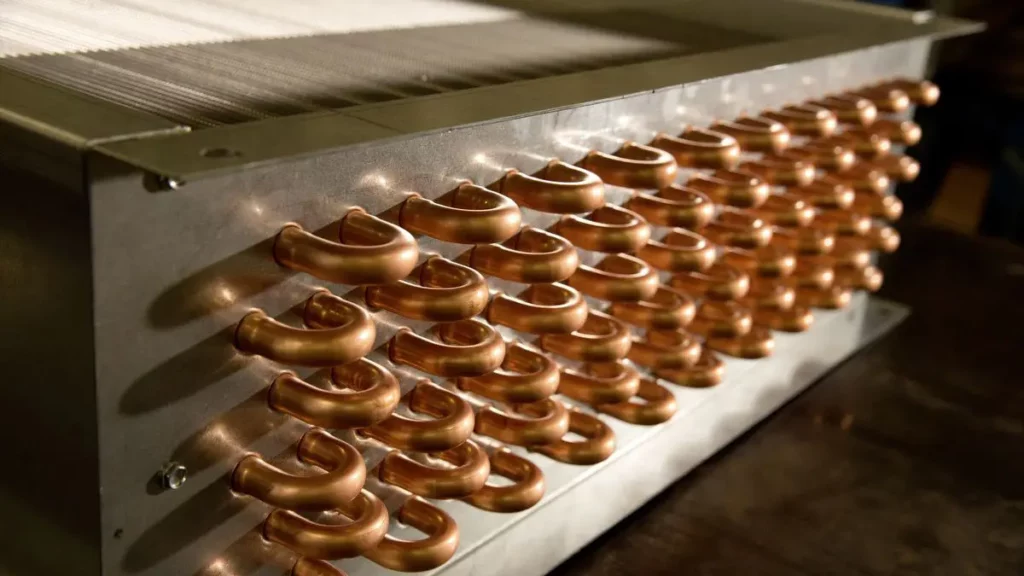
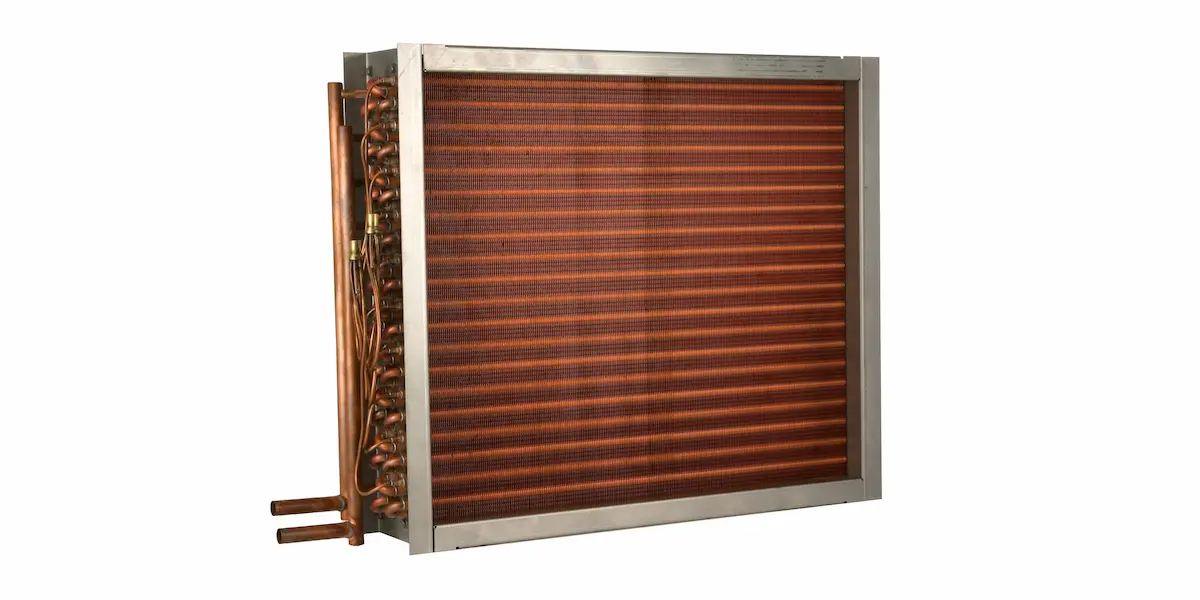
Commercial evaporator coils are commonly constructed with copper tubes and aluminum fins. The tubes carry refrigerant through the coil, while the fins increase available surface area for heat transfer. Headers, distributors, connections, and circuiting help control and distribute refrigerant throughout the coil.
The exact construction depends on the application. Rows, fin spacing, tube configuration, casing materials, and connection locations can all vary according to performance and installation requirements.
Where is the evaporator coil located? In many commercial HVAC configurations, the evaporator coil is located within an indoor unit or air handler where conditioned air can move across its surface. The exact position depends on equipment design, airflow direction, and available mechanical space.
Design Factors That Impact Evaporator Coil Performance
Effective evaporator coil design requires more than matching the physical dimensions of existing equipment. Capacity and performance depend on multiple variables that must work together.
Important design considerations include:
- Rows and fin density: Influence available surface area for heat transfer and overall cooling capacity.
- Tube arrangement and circuiting: Affect refrigerant distribution, velocity, and pressure drop. Proper circuiting helps refrigerant move consistently throughout the coil.
- Airflow: The required volume and velocity of air must move across the coil to support effective cooling and dehumidification.
- Refrigerant conditions: Refrigerant type, pressure, temperature, and flow must correspond with HVAC system requirements.
- Dimensions and orientation: Coil size, casing configuration, and installation orientation must work with the available equipment and mechanical space.
- Materials and coatings: Fin, tube, casing, and protective coating options should reflect environmental and operating conditions.
Common Evaporator Coil Problems and Maintenance
A dirty evaporator coil can interfere with heat transfer and restrict airflow. As dirt and debris accumulate on the coil surface, the system may have difficulty maintaining the required cooling capacity. In some applications, restricted airflow can allow the coil surface temperature to fall low enough for moisture to freeze.
Other potential problems include corrosion, physical damage, blocked condensate drainage, and refrigerant leaks. These conditions can affect both cooling and humidity control. Warm air blowing from a system or unexplained changes in performance may indicate that the coil or another HVAC component requires inspection.
Keeping the evaporator coil clean helps preserve airflow and effective heat transfer. Filters should also be inspected and maintained according to equipment manufacturer recommendations and facility requirements to limit contaminants reaching the coil.
Maintenance personnel should inspect fins, tubes, connections, casings, condensate pans, and drainage components based on the needs of the facility. Rather than following a universal maintenance interval, commercial operators should establish schedules according to equipment requirements, operating conditions, environmental exposure, and system usage.
When to Repair or Replace an Evaporator Coil
Not every performance problem requires a new coil. Isolated damage or certain serviceable issues may be repairable depending on the condition of the equipment and the requirements of the application.
Replacement may be more practical when a coil experiences significant corrosion, recurring refrigerant leaks, extensive physical damage, or repeated performance problems. A replacement should also be evaluated for compatibility with the existing air handler, air conditioning unit, or other HVAC equipment.
For data centers, healthcare facilities, manufacturing plants, and other mission-critical environments, the decision extends beyond the condition of the coil itself. Potential downtime, reliability requirements, project schedules, and replacement lead times can all affect whether repair or replacement is the appropriate solution.
Replacement requirements can vary considerably across commercial applications. Dimensions, materials, capacity, circuiting, refrigerant requirements, accessibility, and system configuration can all influence the scope of an evaporator coil replacement project.
Selecting Custom and Replacement Evaporator Coils
Selecting an evaporator coil begins with accurate system and performance information. For replacement applications in particular, the new coil must fit the existing equipment while delivering the required capacity and operating performance.
Key specifications to identify include:
- Coil dimensions and configuration
- Required cooling capacity and airflow
- Refrigerant and operating conditions
- Number of rows and fin density
- Tube arrangement and circuiting
- Connection requirements
- Tube, fin, and casing materials
- Protective coatings
- Coil orientation
- Condensate management requirements
Custom manufacturing can be particularly valuable when original equipment is no longer available or when a standard AC evaporator coil does not meet the dimensions or specifications of a commercial system.
Accurate system information helps ensure the replacement coil is designed for the required performance while integrating properly with existing air handling equipment.
Custom Evaporator Coils from Precision Coils
Precision Coils manufactures a complete line of custom-built evaporator coils for commercial and industrial HVAC applications. Solutions are available for replacement, retrofit, OEM, and new equipment projects, with coils manufactured to customers’ precise dimensions, material preferences, and performance requirements.
Construction options include copper tubes, multiple fin materials, protective coatings, and stainless steel casings for specialized or demanding environments. This flexibility allows Precision Coils to manufacture coils for a wide range of air handling and cooling equipment.
With multiple manufacturing facilities strategically located throughout the U.S., Precision Coils offers fast standard lead times along with expedited options for projects where minimizing downtime is critical. This combination of manufacturing flexibility, quality, agility, and responsive customer service supports both planned projects and urgent replacement requirements.
Precision Coils’ evaporator and condenser coils are recognized as ANSI/UL 1995 and CAN/CSA C22.2 compliant. Customers also have access to responsive engineering, sales, and customer service support throughout the selection and ordering process.
Request a Custom Evaporator Coil
Whether you need an evaporator coil for new equipment, an OEM application, a retrofit, or an urgent replacement, Precision Coils can manufacture a solution around your specific system requirements.
Request a quote based on your coil dimensions and performance specifications, or contact Precision Coils for assistance selecting the appropriate solution. Fast standard and expedited lead-time options can help keep both planned and urgent replacement projects moving.