Blog
Types of Condenser Coils: A Guide to Designs and Applications
Different types of condenser coils are available to meet the heat rejection, space, environmental, and operating requirements of HVAC/R equipment. Common configurations include air-cooled, water-cooled, formed, and custom designs, with additional options for materials, coatings, tube sizes, fin spacing, rows, and circuiting.
Choosing among the different types of condenser coils requires looking beyond a single design feature. The appropriate configuration depends on the equipment, required performance, and conditions in which the coil will operate.
What are the Different Types of Condenser Coils?
The types of condenser coils used in HVAC/R equipment can be categorized by how heat is rejected as well as how the coil itself is constructed. Air-cooled and water-cooled condenser coils use different heat-rejection methods, while formed and custom coils address specific equipment layouts and performance requirements.
Within these broader categories, condenser coil design can be further customized. Tube diameter, fin material and spacing, number of rows, circuiting, casing, and protective coatings can all be selected according to the application. This means two condenser coils that fall into the same general category may have very different designs.
How Do Air-Cooled Condenser Coils Differ?
Among the most common types of condenser coils, air-cooled designs reject heat using ambient airflow across the coil surface. They are widely used in commercial HVAC/R systems and other equipment designed around air-cooled heat rejection.
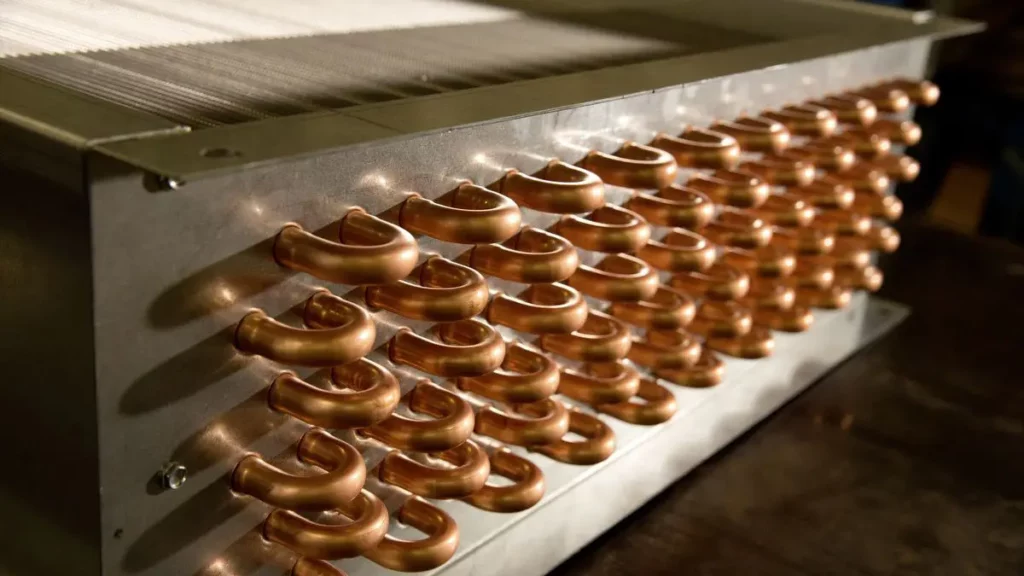
A typical air-cooled condenser coil uses copper tubing and aluminum fins. Refrigerant travels through the tubes while airflow passes across the extended fin surface. Depending on the application, the coil can be engineered with different tube sizes, fin spacing, rows, and circuit arrangements.
Airflow is particularly important when designing this type of condenser coil. Fin density, coil depth, and available surface area influence heat transfer as well as air-side pressure drop. These variables must be balanced with the airflow available from the equipment.
Outdoor operating conditions matter as well. Moisture, salt, dirt, industrial contaminants, and other environmental factors may influence fin, casing, and coating choices.
When are Water-Cooled Condenser Coils Used?
Water-cooled designs are another of the primary types of condenser coils used in HVAC/R applications. Instead of rejecting heat directly to ambient air, these coils transfer heat using water. They are commonly associated with commercial and industrial systems where water-based heat rejection is already incorporated into the equipment.
Water-cooled designs can be useful where available space or airflow makes an air-cooled configuration less practical. Important considerations include entering water temperature, flow rate, allowable pressure drop, capacity, and material compatibility. Water quality can also influence long-term performance, making the characteristics of the water loop an important part of coil selection.
Rather than viewing air-cooled or water-cooled designs as universally better, the appropriate option depends on how the overall HVAC/R system is designed to reject heat.
What are Formed and Custom Condenser Coils?
Not every piece of HVAC/R equipment can accommodate a standard flat coil. Formed condenser coils allow the heat transfer surface to fit within equipment with specific cabinet dimensions, layouts, or space limitations.
Depending on the equipment, a coil may be formed into an L-shaped, U-shaped, wraparound, or other application-specific configuration. These designs can be particularly useful in packaged equipment and other systems where available space must be used efficiently.
Custom condenser coils can also be designed for replacement applications. Older or discontinued equipment may require a coil that matches an existing footprint rather than an off-the-shelf component.
Accurate measurements are essential in these situations. Overall dimensions, connection locations, casing requirements, circuiting, and other physical characteristics must be considered alongside performance requirements. Matching these details can help minimize modifications when installing the replacement coil.
How Does Condenser Coil Construction Affect Performance?
Although the different types of condenser coils are often categorized by their overall configuration, construction details can create significant differences within each category. Tube size, fin spacing, number of rows, and refrigerant circuiting are among the variables used to tailor condenser coil performance.
Fin density affects the amount of heat transfer surface available within a given coil size. Increasing the number of rows can also provide additional surface area and increase the depth of the coil. These changes, however, need to be evaluated alongside airflow and pressure drop.
Tube diameter and circuiting influence refrigerant flow through the condenser coil. The appropriate arrangement depends on the equipment and its performance requirements.
For this reason, simply adding more rows or using tighter fin spacing does not necessarily create a better condenser coil. The individual design variables need to work together within the requirements of the equipment.
How Do Materials and Coatings Affect Condenser Coil Selection?
Material selection can further distinguish the different types of condenser coils and their suitability for specific environments. Copper tubes with aluminum fins are common, but some applications may call for alternative materials or additional protection.
Copper fins can be specified for certain applications, while casing options can include materials such as galvanized steel and stainless steel. Protective coatings may also be used when coils will operate in environments where moisture, salt, chemicals, or other corrosive contaminants are concerns.
The appropriate materials depend on the operating environment, durability requirements, maintenance considerations, and overall coil design.
How Do the Different Types of Condenser Coils Compare?
Each condenser coil configuration addresses different equipment needs:
- Air-cooled: Uses ambient airflow for heat rejection.
- Water-cooled: Uses water as the heat-transfer medium.
- Formed: Fits equipment with specific geometries or space constraints.
- Custom replacement: Matches existing equipment when a standard replacement is unavailable.
- Specialty-material or coated: Addresses environmental or corrosion-related requirements.
These categories can overlap. A custom air-cooled condenser coil, for example, may also use a formed configuration and specialty materials based on the application.
What Should You Consider When Choosing a Condenser Coil?
Choosing between the different types of condenser coils starts with understanding the equipment rather than selecting a configuration in isolation.
Engineers, contractors, and equipment owners should consider factors such as:
- Airflow or water-flow requirements
- Required capacity and refrigerant
- Allowable pressure drop
- Tube size and number of rows
- Fin spacing and material
- Refrigerant circuiting
- Overall dimensions
- Connection sizes and locations
- Casing materials and coatings
- Environmental exposure
Replacement projects also require careful attention to the existing equipment. Matching both physical dimensions and performance requirements helps ensure the new condenser coil integrates properly with the system.
Find the Right Type of Condenser Coil for Your Application
Understanding the different types of condenser coils is the first step toward selecting a design suited to the equipment and its operating requirements. Precision Coils manufactures condenser coils with customizable dimensions, materials, circuiting, casing, and other design options for a range of HVAC/R applications.
For new and replacement applications, PC Select can help streamline coil selection, pricing, and ordering. When an urgent replacement is required, Precision Coils also offers its Quick Build Program for qualifying coils.
Need help determining which condenser coil configuration fits your equipment? Provide your specifications and operating requirements or contact Precision Coils to discuss your application.