Blog
Types of Evaporator Coils for Commercial HVAC/R Systems
Evaporator coils are essential heat-transfer components in commercial HVAC/R systems. As refrigerant moves through the coil, it absorbs heat from the air passing across the coil surface. This process helps provide the cooling and dehumidification required for air-conditioning and refrigeration applications.
The types of evaporator coils used in HVAC/R equipment can vary based on airflow configuration, construction, materials, circuiting, and application requirements. Understanding these differences can help mechanical contractors, facility managers, engineers, and OEMs select the right coil for a new system, retrofit, or replacement.
How Do Evaporator Coils Work?
In a direct expansion (DX) system, refrigerant enters the evaporator coil at a low temperature and pressure. As warmer air passes across the coil, the refrigerant absorbs heat and evaporates. The refrigerant vapor then travels to the compressor and eventually the condenser coil, where the absorbed heat is released.
This heat-transfer process also removes moisture from the air. When the coil surface is below the air’s dew point, water vapor condenses on the coil and drains away as condensate.
The evaporator and condenser coil therefore perform complementary functions. The evaporator absorbs heat from the conditioned air, while the condenser rejects heat elsewhere in the refrigeration cycle.
Common Types and Configurations of Evaporator Coils
Evaporator coils can be classified in several ways, including their physical construction, refrigerant-feed method, application, and airflow configuration. In commercial HVAC/R systems, the appropriate configuration often depends on the equipment layout and direction of airflow.
DX evaporator coils can accommodate horizontal, vertical, or universal airflow configurations.
This flexibility is especially important when designing a custom coil or replacing an existing coil within an air-handling unit or other equipment with fixed dimensional requirements.
A-coils, N-coils, and slab coils are other terms commonly encountered in air-conditioning applications. These names generally describe the physical shape of the coil. For commercial applications, however, matching the coil’s dimensions, airflow, capacity, refrigerant, and other operating requirements is often more useful than selecting a coil based on shape alone.
Finned-Tube DX Evaporator Coils
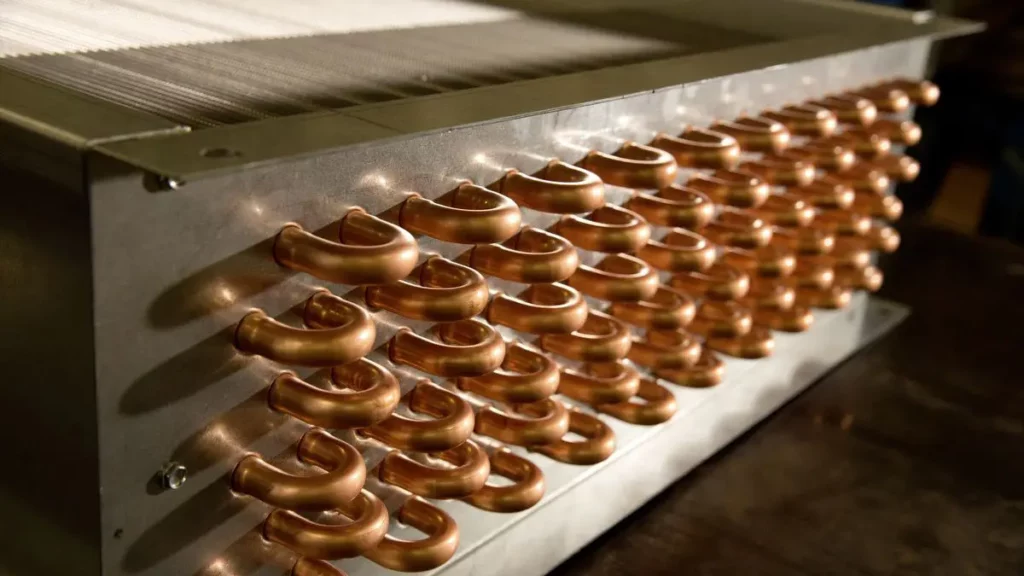
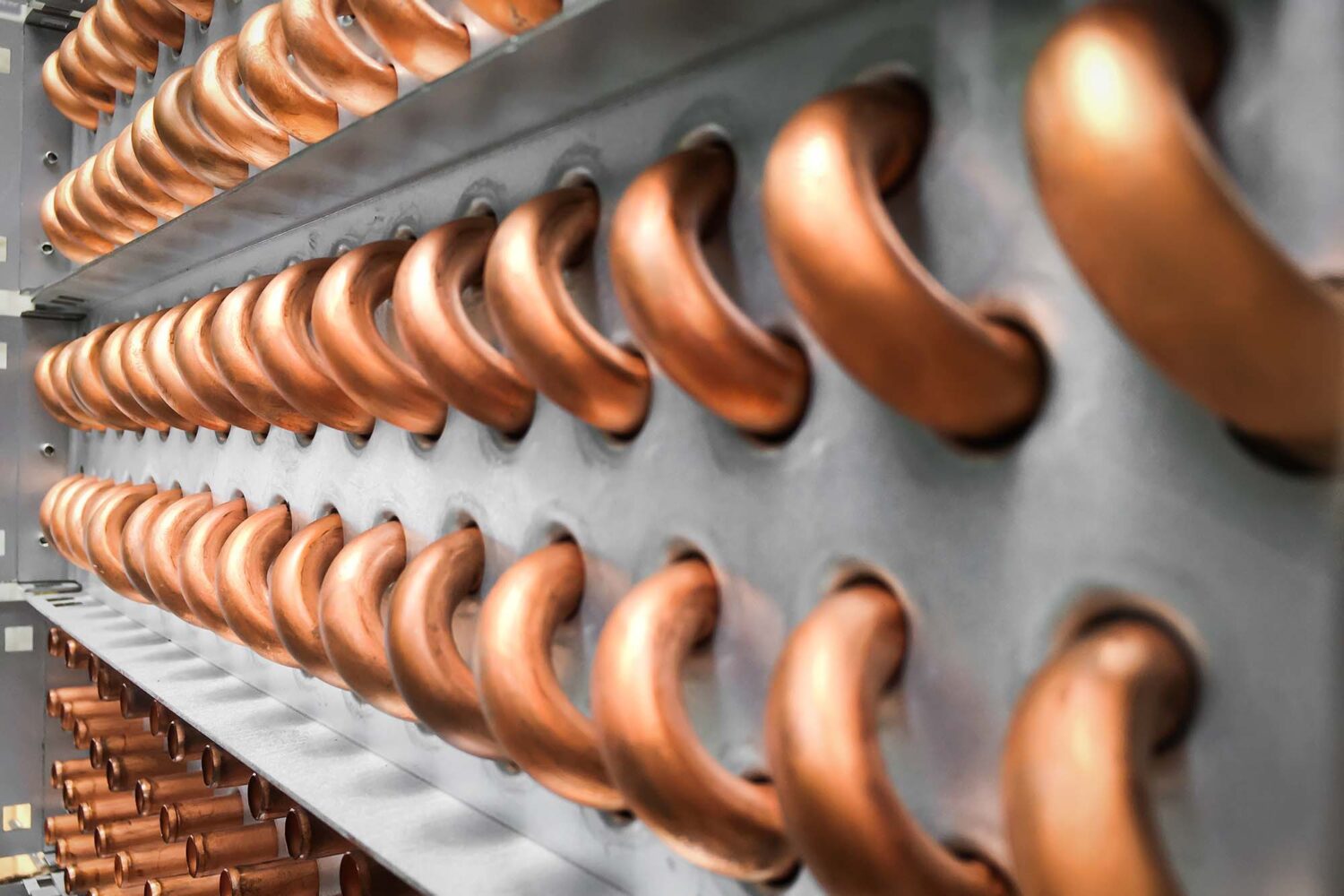
Finned-tube coils are commonly used for air-side heat transfer in commercial HVAC/R equipment. Refrigerant travels through the tubes, while attached fins increase the surface area available to exchange heat with the passing air.
Precision Coils manufactures custom DX evaporator coils for applications including air-handling units, rooftop packaged units, split systems, refrigeration cases and coolers, variable refrigerant flow systems, and other commercial cooling applications.
The construction of a finned-tube coil can be adjusted to meet different performance requirements. Precision Coils manufactures DX evaporator coils with one to 12 rows and offers multiple tube diameters and fin configurations. Coil depth, fin spacing, circuiting, and airflow requirements are among the factors that determine the appropriate configuration for a particular application.
Evaporator Coil Materials and Construction Options
Material selection can affect heat transfer, durability, corrosion resistance, and the suitability of an evaporator coil for its operating environment. Copper tubing with aluminum fins is a common HVAC/R configuration because of the materials’ heat-transfer characteristics.
Other environments may require different materials. Available options can include copper fins, stainless steel or copper casings, specialized fin materials, and protective coatings. These alternatives can be considered when coils will operate in corrosive or otherwise demanding conditions.
Fin spacing is another important consideration. Fins per inch (FPI) affects the amount of heat-transfer surface and the resistance to airflow through the coil. Precision Coils also offers 3/8-inch, 1/2-inch, and 5/8-inch tube configurations. These construction variables should be evaluated together rather than selecting a coil based on one specification alone.
Refrigerant, Circuiting, and Coil Performance
An evaporator coil must meet both the physical and performance requirements of the HVAC/R system. Important selection factors include cooling capacity, refrigerant type, airflow, entering and leaving air conditions, evaporator temperature, number of rows, and circuiting.
Circuiting determines how refrigerant flows through the coil. Proper circuiting helps provide the distribution and heat transfer required for the intended operating conditions. Distributor configuration must also match the application. Precision Coils offers standard and hot-gas distributor options for its DX evaporator coils.
The evaporator coil should also be compatible with the other components of the refrigeration system. Matching the coil to the required refrigerant, capacity, airflow, and operating conditions helps the system perform as designed.
Choosing a Replacement Evaporator Coil
Evaporator coil replacement involves more than finding a coil that fits within the available space. A replacement must meet the HVAC/R system’s dimensional and performance requirements.
Before requesting a replacement coil, gather information such as:
- Existing coil dimensions
- Airflow direction and CFM
- Refrigerant type
- Required capacity
- Entering air conditions
- Evaporator temperature
- Tube size
- Fin material and FPI
- Number of rows
- Connection sizes and locations
- Casing requirements
Existing drawings and equipment specifications can also provide valuable information when replacing a coil. When drawings are unavailable, carefully documenting the existing coil’s dimensions, connections, materials, and operating conditions can help establish the required replacement configuration.
Evaporator Coil Maintenance and Signs of a Problem
Clean coil surfaces and adequate airflow are important for maintaining heat-transfer performance. Dirt and debris on the coil can restrict airflow and reduce the surface area available for effective heat exchange.
Potential signs of an evaporator coil or system problem include reduced cooling performance, frost or ice buildup, restricted airflow, refrigerant leaks, damaged fins, and condensate drainage problems. Ice buildup can result from multiple conditions, including restricted airflow and refrigerant-related issues, so the underlying cause should be diagnosed before assuming the evaporator coil requires replacement.
Maintenance and cleaning procedures should follow the requirements of the equipment and coil manufacturer. Installation details such as airflow direction, refrigerant piping, suction-line insulation, and condensate drainage can also affect coil performance.
Custom DX Evaporator Coils From Precision Coils
Precision Coils manufactures custom DX evaporator coils for replacement, OEM, and design-build applications. Coils can be manufactured according to specific dimensional, material, connection, circuiting, and performance requirements, making it possible to match existing equipment or meet the needs of a new HVAC/R system.
Quality control is also an important part of refrigerant coil manufacturing. Precision Coils tests its refrigerant coils as part of its quality-control process to help identify potential leaks before shipment.
Customers can use PC Select, Precision Coils’ coil selection and pricing software, to select and design coils. Direct Order Entry (DOE) within PC Select also provides a streamlined way to place orders and access order information.
For time-sensitive projects, Quick Build options are available for eligible coils based on project specifications and manufacturing requirements. Providing complete information at the start of the selection process can help avoid delays.
If you need a custom or replacement DX evaporator coil, contact Precision Coils with your coil dimensions, drawings, refrigerant type, operating conditions, and project requirements to request a quote.